A magazine cover.
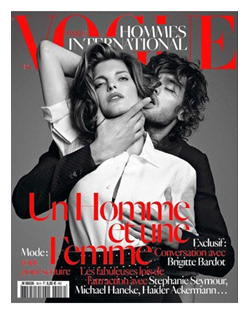 A controversial pose.
Or is it?
Apparently, certain women’s groups are up in arms over this French Men’s Vogue International cover, according to a short piece I read in Yahoo Shine’s Daily Shot.
Several domestic violence organizations are claiming that the male model appears to be choking the female model, the gorgeous Stephanie Seymour, and this associates violence against women with sex, not to mention fashion.
What do you think?
I have to admit, given the present popularity of Fifty Shades of Gray (which I have not read), this particular form of embrace – and that’s what it looks like to me – is something I wouldn’t have considered bothersome.
How many men reach around from behind to kiss a woman in, granted, a physically “possessive” manner? And how many women absolutely adore it?
What Women Find Sexy
A woman’s definition of sexy? I imagine we’d find a wide variation – and not solely based on demographics, or elements of life experience and cultural upbringing. And of course, there’s what a woman finds sexy in a man, and what a woman finds sexy in herself. In either case, one woman’s “irresistible” is another woman’s “no thank you.”
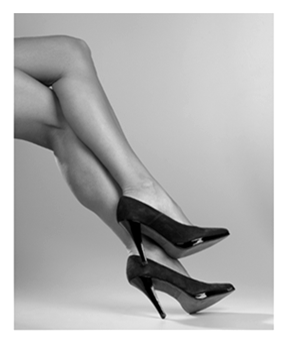 How do we explain these differences in sexual chemistry? Are they innate? Are they learned? How closely linked are they to a woman’s psychological makeup?
I love my sexy shoes. I love when a man loves my sexy shoes and, well… we’ll leave it at that.
But don’t many of us find pleasure in mixing up the menu? Don’t we enjoy a diversity of moods – and styles, to keep our relationships fresh and exciting?
Who else recalls the episode of Sex and the City in which Miranda is dating an obnoxious character whose overbearing personality drives her crazy? Yet she confides in the other girls that the sex is great, and she says something to the effect of: “Why is it that what I hate in life I love in bed?”
Stir Love, Not War
Is the image above simply a posed prelude to passion?
The Autumn-Winter 2012-2013 issue of Men’s Vogue International dishes up “Un Homme et Une Femme,” (a man and a woman), featuring a bit of blurring of male-female boundaries and a piece on Brigitte Bardot, among others.
However, The New York Daily News refers to Ms. Seymour as being “choked and groped.”
Seriously?
Let me be clear. I abhor violence, period. And reading the New York Daily News article, it sounds like the photographer who took the picture walks a fine line, to say the least. But I will add that I don’t find this male model attractive, I don’t see his hands as attacking or “groping,” and frankly, I would’ve passed this cover by without a second glance.
Still, as much as I’m enamored of fashion (and all the glorious magazines I’ve loved since childhood), we do seem to be on a perpetual quest to push the envelope. Sometimes the results are “art” or at least intriguing. Other times, not so much.
Adult Men, Adult Women
 Don’t we all draw a line – somewhere – at what we consider appropriate behavior?
Adult men and women enjoying their mutual pleasure? Seems reasonable to me.
But the line we draw changes as we go through life – becoming more restrictive or less. And I, personally, draw a line at anything to do with children.
While I realize we could debate the age at which a woman ought to be considered an adult, especially for media purposes, surely we can likely agree that 13 or under is a child.
For example, the use of 10-year old French Vogue mini-models in the summer of 2011, posed provocatively, is a different story.
The fact that children are employed to sell adult products with an ample dose of sex appeal? That barely pubescent bodies model clothing to “ordinary” women, adding to the struggle with body image and self-esteem? I find something wrong in that picture, just as I was appalled at marketing bras to very little girls, another issue that made the media rounds last year.
As for the image of Stephanie Seymour above, it is not offensive – to me.
And the cover controversy? I’d say the so-called stir sells magazines and page views, but it doesn’t sell violence against women.


Not thrilled with any photo that appears to compromise women.
His hand appears gentle to me. Just curious. Did you read the Yahoo Shine interpretation?
The fact that the cover is in black and white (no colour, all grey “shades”) would seem to make it obvious as a reference to the livre du jour so dominance is implied. There is a hint that the dominance is inverted (Stephanie over the male model, we don’t see her other hand) and it definitely looks consensual which in the end, is the important factor.
Very observant, batticus. Et je suis tout à fait d’accord.
Passion is physical. When you look from a distance, just what does passion look like? Possibly something bad?
Wikipedia: Andrea Dworkin: Intercourse
In 1987, Dworkin published Intercourse, in which she extended her analysis from pornography to sexual intercourse itself, and argued that the sort of sexual subordination depicted in pornography was central to men’s and women’s experiences of heterosexual intercourse in a male supremacist society. In the book, she argues that all heterosexual sex in our patriarchal society is coercive and degrading to women, and sexual penetration may by its very nature doom women to inferiority and submission, and “may be immune to reform.”
Sexual penetration may by its very nature doom women to inferiority and submission? What?
Wikipedia: Yin and yang
The Taijitu is one of the oldest and best-known life symbols in the world, but few understand its full meaning. It represents one of the most fundamental and profound theories of ancient Taoist philosophy. At its heart are the two poles of existence, which are opposite but complementary. The light, white Yang moving up blends into the dark, black Yin moving down. Yin and Yang are dependent opposing forces that flow in a natural cycle, always seeking balance. Though they are opposing, they are not in opposition to one another. As part of the Tao, they are merely two aspects of a single reality. Each contains the seed of the other, which is why we see a black spot of Yin in the white Yang and vice versa. They do not merely replace each other but actually become each other through the constant flow of the universe.
Passion is physical. And it takes a bit of the physical to take two and join them as one.
I think batticus hit the nail on the head: the issue is one of consent. To me, Stephanie Seymour’s face suggests complicity, which makes me say to each, her own.
Then again…I’m not familiar with this publication, but I suspect this shot would never make the cover of a women’s fashion magazine. If it were on the cover of, say, American Vogue, it might be easier to sell the idea that this is a shot of a mutually enjoyable encounter rather than one of a man “groping” a woman. Maybe?
Dear Big Little Wolf,
I have been thankful for quite a while now for your willingness to address topics as an adult woman. This is no exception. The attack on the Vogue cover seems as pernicious as the attempt to impose a “When I say no, I mean no” rule on sex, assuming of course that we are dealing with street smart adults. And there must be a better way to talk to adolescents about these things. It simply isn’t always right! Thank you for lighting the grey areas of life, and for beautiful writing.
Davey’s House, I would be remiss if I didn’t reply to your comment immediately – and carefully. First, thank you for your kind remarks about my writing. I try to look beyond stereotypes and encourage discussion that recognizes many ways to live and many ways to think. We could all learn from each other by doing a bit more listening.
I also believe that labels are problematic (if not damaging), and equally so, “absolutes” in so many domains including relationships.
In less euphemistic terms, I believe we need to be more tolerant, if not open-minded. And in my opinion what goes on between consenting adults is their business, which is reflected in my writing.
On this topic, and the topic of sexuality in general, we’re so full of contradictions in this country. What is taken as a more natural element of adult life in some countries and cultures is a problem here. That said, I think you’re touching on a number of issues that deserve their own discussions, and on which I have some things to say.
I firmly believe that women are generally at more risk of harm than men in the social arena. When we take encounters with strangers (or near strangers) lightly, or we glamorize them, I believe we do a disservice to our women in pretending that there isn’t inherent danger.
As for “no means no,” I find that to be an excellent rule. When I say no, I mean no. This may be a gray area in some exceptional circumstances, between intimate partners, but that’s another conversation. As you may already be aware, safe words to indicate “no” are an essential part of certain games. In other words, no means no, and without that trust – the relationship cannot exist. Rather than assuming you’re referring to semi-sappy theoretically romantic seduction scenes on television, I would be interested to know in what context you feel no doesn’t mean no.
When it comes to our adolescents and what we teach them through our actions as well as our words, that’s a critical conversation and worthy of a great deal of attention and care. I’m glad you brought it up. Personally, I don’t think there’s a “right way” or “wrong way” to address this issue, only a variety of ways that suit our children as individuals, our many different beliefs, not to mention the cultural context in which we are raising them.
I thank you for joining the discussion. I hope you will again. I believe these shades of gray have always been present. We’re only at the beginning of being willing to give voice to them.
Whatever is going on there, that cover doesn’t make me want to buy the magazine.
No need to say that I completely agree with you on any use of underage girl in any provocative situation, or even in position of a woman when she’s not. But sincerely this Vogue cover, where would be the problem? As we say in France “Il n’y a pas de quoi fouetter un chat” (“no reason to cry over spilled milk” in USA?).
It’s nothing else than playing! Sensual playing with images as it always existed and period! Look at this famous photo of Serge Gainsbourg and Jane Birkin (in middle of the 70s).
They were lovers and living together. The photos were clearly just playing with the idea of this very classic French cliché: The bad guy that you love anyway even though he’s beating you etc… which was exactly the situation that was singing Mistinguette in “C’est mon homme.”
That may be a famous photo, François, but I have to tell you – I hate it.
I find nothing remotely appealing about it. On the contrary.
As for that particular cliché, I loathe it as well. It may have been acceptable – more acceptable – a generation or two back, but I find it appalling. Et ça n’a rien à voir avec les jeux, et un plaisir dans les expressions “mon homme” ou “ma femme.”
I listened to a podcast that discussed how we still live in a sexually shaming culture. I wonder if this picture – with its obvious BDSM reference – is part of that. Some people enjoy that type of relationship.
Since I can’t read French, could you tell me if that cover shot is referencing an article in Vogue? I believe context is an important part of this article.
Amber, the promotional copy on the web that is associated with this image translates to: “A man and a woman, obviously lovers, but also brother and sister, mother and son, creator and muse… A special issue devoted to this wondrous and fragile balance that connects two beings.”
(Clearly, the attempt is to be provocative. But then, there’s nothing new in that.)
If there were actual signs of violence here, I’d be all over this as inappropriate. I don’t see it. I see sexy, consensual play – intended to sell magazines and page views.
I’ve been thinking about this since I read it this morning. I’m sure that personal experience may influence the reaction to this photo. A woman who has experienced violence from a man may have a hard time with this photo. Someone who does not have that history may see the photo as non-threatening. But given the very real problem of domestic violence, mainly against women, not sure that this photo is a great idea.
I also wonder about how young boys/men (and girls and young women) might interpret this photo. Think we all agree that we want to be very clear to them that violence is never acceptable. Not sure that a young boy or girl seeing this magazine cover on the coffee table would be able to figure out that this image is intended to be sexy and playful.
Excellent points, deb.
I see what you mean about “no means no”, point taken, especially since we are more at risk. And yes, I was thinking of exceptional situations where it would not apply, where it is part of a game, but that would require a basis of trust with a partner.
Thank you for coming back and clarifying, Davey’sHouse. Your comment has also made me consider several related issues – situations in which young women (especially) may feel they’ve gotten themselves into a fix, and they can no longer say “no.” There may be no risk of being harmed physically, but our culture still operates as if women who “ask for it” in certain ways can’t say no. Another important discussion, for another day.
Vogue is so not me. Let’s be honest – this is exploitive with a purpose to get attention and sell magazines. For better or worse, this is very old stuff. Although I have my own feelings about the nature and varieties of sexuality (expressed on other posts and at my blog), I am basically bored with this type of magazine cover and it only reinforces why I would never buy/support such an overpriced exploitive rag (Oops, my Quaker Testimonies of Simplicity and Integrity must be overwhelming my supposed Quaker niceness Or maybe it’s because I was involved with a major demonstration all day [we were peacekeepers/marshals for the march] and Vogue’s attempt to create buzz seems so trivial by comparison). In any case, the editors seem to have correctly sensed that this sort of thing can still get a response out of readers, judging from the number of responses that you received. Meanwhile, sex is good, and forget about magazines.
I agree that it seems a bit odd in an era when 50 Shades has been at the top of my Amazon most purchased books for someone to complain about this photograph.
The woman doesn’t look afraid; the man doesn’t look angry or menacing. They look like a couple about to have passionate sex.
It doesn’t offend me at all. It is sexy and provocative, but it doesn’t make me think about domestic violence. Not at all. I also agree that what really works for many people in the bedroom is stuff that seems silly or maybe even disgusting out of that context. That’s the nature of human sexuality. The naughty or forbidden, maybe something dangerous, or even a little perverse (just a little. no children or excrement ever!) turns people on.
Just a little precision, BigLittleWolf, I wasn’t saying that I liked the photo, but just that everybody was understanding that it’s « pour de rire » (just for fun) as we say in France. By the way it’s true that it’s not very welcomed for me that such things should come from Serge Gainsbourg, since he proved many times that he’s very capable to be a total jerk with women in real situations, and even more when he was over drunk which happened too often. A certain Whitney Houston kept a bad memory of that.
Same as you, I always hated the cliché I talked about (so much popularized by Piaf and others) but sadly in the 30s, 40s, 50s, it was quite universal, I mean your side of the Atlantic included, no? 🙂 But as early as 1956 Boris Vian fought this cliché making a fun of it with a song that I always adored for being so ironic and funny: “Fais moi mal, Johnny!” (hurt me, Johnny!) wonderfully sung by Magali Noël.
I think passion can be physical too and frankly the male model on the cover doesn’t frighten me. He looks young and innocent. But we’re adults reacting and giving our opinions. A child may see it differently and that’s what we need to be conscious of should this kind of material be within their grasp.
appreciated the post and comments. I’m with Chloe that the photo just looks like two people about to have passionate sex. I’m with you, BLW, that no means no.
I wonder what Andrea Dworkin would say about penetration now, given how far we’ve moved from the patriarchy she was writing about.